 An Affiliate of the National Trades Union Congress (NTUC)
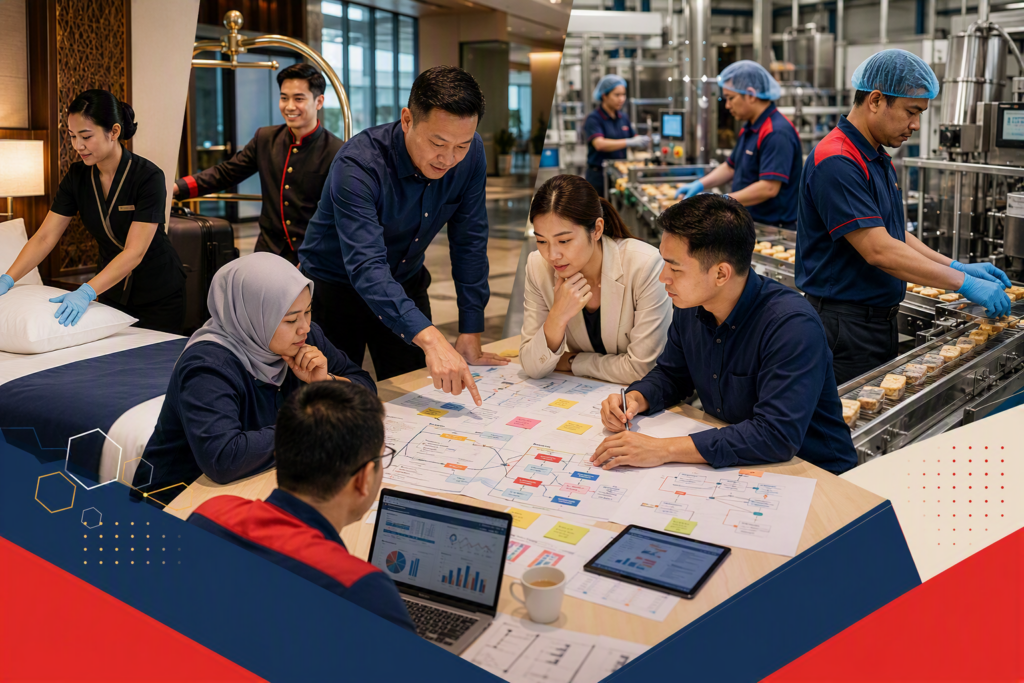
Turn your transformation plan into actionable steps for success.
Enterprise leaders in the food manufacturing and hospitality sectors know that continuous innovation is essential for long-term resilience. With shifting consumer behaviours, tight labour markets, and the accelerated adoption of digital tools such as AI and automation, organisations cannot afford to leave strategic growth plans on the shelf.
Have a transformation plan but are unsure whether it will work in practice? Want to improve productivity and respond to technology disruption, but are uncertain which solutions to adopt? You may know that your business needs to evolve—from redesigning workflows to upskilling staff—but the exact next steps may still be unclear.
At the Food, Drinks and Allied Workers Union (FDAWU) and NTUC’s Training and Transformation team, we work with companies to navigate this terrain through strategic initiatives such as Operation and Technology Roadmap (OTR) workshops. These engagements help business leaders diagnose enterprise-level challenges, evaluate long-term technology pathways, and align transformation outcomes across the organisation.
The Common Gap:
Even after identifying a high-level strategy, many companies struggle with the next critical step: translating that strategy into a clear current-state assessment, future-state design, operational KPIs, and an immediate milestone action plan.
What they need is a localised, practical, and context-specific training-plus-consultancy clinic. Forward-thinking enterprises understand that to maximise return on investment, transformation should not move directly from a boardroom roadmap to the purchase of expensive vendor equipment.
To provide enterprises with this crucial staging environment, Republic Polytechnic (RP) has launched the new Go Business Transformation (GoBT) programme. Developed by RP’s School of Hospitality alongside NTUC and FDAWU, this 4-day programme serves as an essential bridge between high-level enterprise strategy and capital investment readiness.
The 5-Step Applied Project Methodology
The GoBT programme replaces generic, theoretical classroom training with action learning and context-specific project consultancy that helps companies move from intent to implementation.
How it works: To enrol, an enterprise forms a project team of at least three core staff members. Instead of analysing abstract case studies, the team brings one live, high-priority operational bottleneck into the workshop to diagnose, test, and solve.
Over a flexible 4-day blended framework, the programme combines intensive, interactive workshops with personalised on-site mentoring conducted at your company premises.
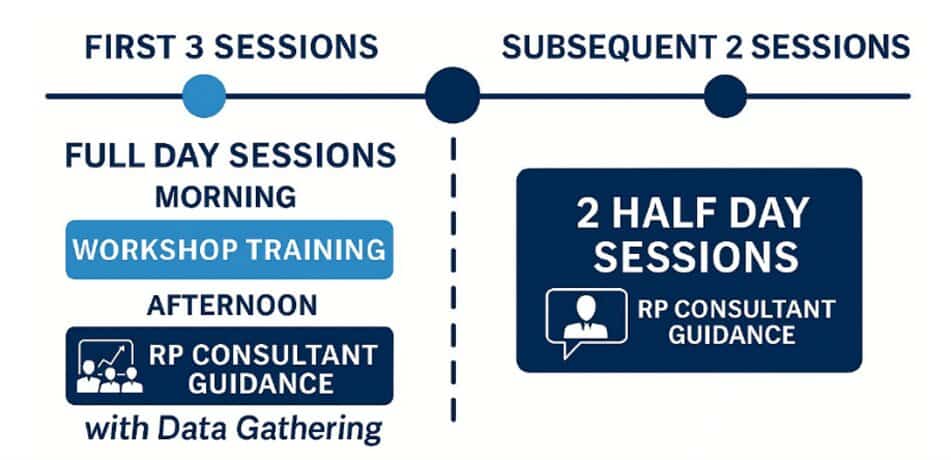
The schedule can be adapted to align with operational priorities. Sessions may be delivered consecutively or spaced out to minimise disruption while reinforcing learning, application, and ownership on the ground:
- Current-State Assessment: Teams use diagnostic process-mapping tools to identify current business challenges and baseline existing operational workflows.
- Future-State Design: Participants co-develop an optimised, future-ready operating model that details how the new process or technology pilot can be executed seamlessly on the ground.
- Impact Measurement: Teams establish data-driven Key Performance Indicators (KPIs) spanning both Enterprise Transformation (process efficiency and resource savings) and Workforce Transformation (upskilling, role evolution, and career pathing).
- Implementation Enablers: Teams identify the required software logic, relevant technology or equipment parameters, staff training plans, and projected capital expenditure.
- Milestone Planning: The team finalises a concrete 60-day operational roadmap with clear, incremental milestones to roll out the pilot smoothly without disrupting production cycles or day-to-day business operations.
Real-World Application
To visualise how this methodology converts broad goals into ground-level improvements, consider two common operational scenarios:
A) Guest Room Service Automation (Hospitality Sector)
- The Strategic Objective:
A mid-scale hotel faces rising manpower costs, labour shortages, and inconsistent guest satisfaction due to reliance on manual room controls and high volumes of service requests for lighting, temperature, amenities, and in-room assistance.
- The GoBT Application:
RP consultants work closely with hotel operations teams to map current-state guest room service workflows and identify inefficiencies. Through facilitated workshops and structured design sessions, the team co-develops a future-state model that integrates smart room technologies (e.g. automated lighting and climate systems, digital service platforms) while redesigning staff workflows to reduce reliance on manual interventions. - The Workforce & Business Outcome:
The hotel is able to validate operational improvements and guest-experience enhancements before committing to full-scale implementation. Automation reduces repetitive service tasks and physical strain on staff, allowing teams to focus on higher-value guest interactions while improving service consistency and supporting productivity-driven wage growth.
B) Production Line Optimisation (Food Manufacturing Sector)
- The Strategic Objective: A mid-scale food manufacturer experiences material variance and erratic throughput on an assembly line due to manual, subjective raw ingredient weighing.
- The GoBT Application: RP consultants work with floor supervisors to analyse line balancing and process-flow constraints. Together, they establish precise hardware requirements for an automatic weight checker and retrain staff on the optimised layout.
- The Workforce and Business Outcome: The team validates potential material-yield savings on-site before the company commits capital to full-scale acquisition. Automation reduces physical strain for mature workers while unlocking productivity gains that can support progressive wage outcomes.
Through close collaboration between FDAWU and Republic Polytechnic, each company’s project team is guided to identify hidden skill gaps, uncover operational opportunities, and build practical solutions that strengthen both business performance and workforce readiness.
Subsidised Capability Development with Minimal Disruption
To minimise business disruption, the workshop and on-site mentoring schedules are structured around the availability of the selected 3-person project team.
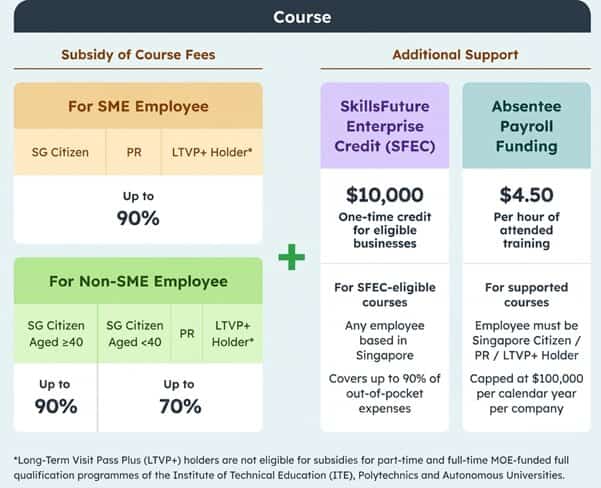
- Up to 90% SkillsFuture Funding: Eligible SME companies may pay as low as $311.15 after funding and GST. The full course fee before GST and funding is $2,450 per participant.
- Accelerating Grant Readiness: The programme identifies workforce transformation needs and captures key workflow data and technical parameters to support future capital grant applications, such as NTUC’s CTC Grant, which provides up to 70% funding for technology upgrades and training support.
Ready to Go One Level Deeper?
Equip your project team with the tools, applied expertise, and structured framework needed to turn long-term corporate strategies into measurable, ground-level outcomes.
Programme slots are coordinated with Republic Polytechnic based on each company’s project pipeline. Companies are encouraged to register early to secure a suitable schedule for their operational project team.